Orangutan Fire Fund
Borneo is Burning NOW!
By the Numbers*
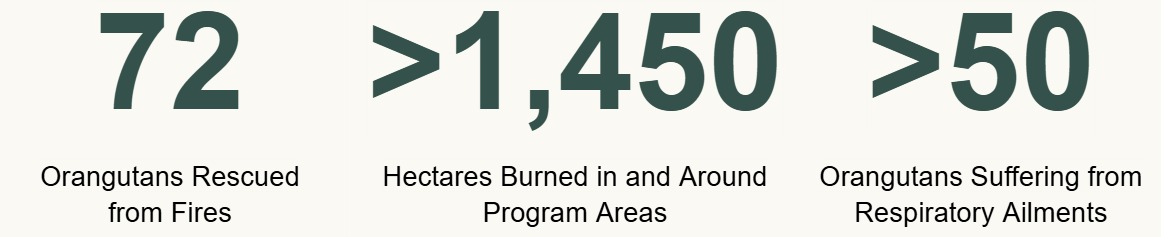
*Combined impact felt by YIARI, BNF, BOSF, and CAN
Update: Oct 16th
In West Kalimantan, much of the fire has been brought under control. In Central Kalimantan, the larger fire outbreaks are being successfully suppressed into smaller areas. The teams are still working hard, especially around Sebangau National Park and the Mawas Conservation Area, where fires have devastated many reforestation areas. The teams are finding hope in the intact forests that remain unburned.
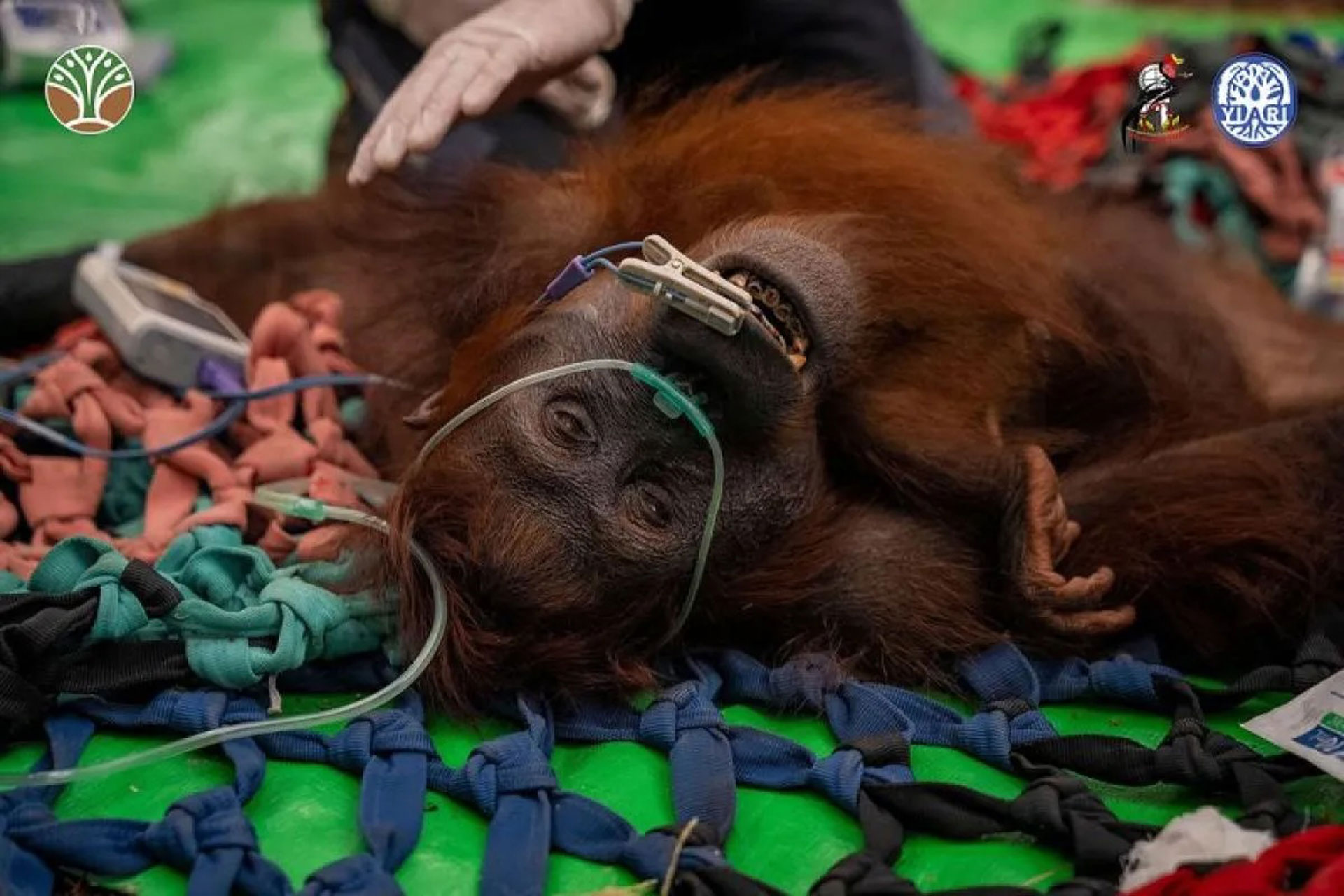
Even as the flames are dying down, the orangutans are still in dire need of help. Many have already sustained injuries or are malnourished due to a lack of water and food. In West Kalimantan, YIARI has now rescued 46 orangutans, leaving the teams exhausted. They have identified another 15 orangutans in need of rescue in the coming days. They also released 8 of the previously rescued individuals into the Batu Nyambu Protection Forest, far from the ongoing fires. In Central Kalimantan, BOSF brought another 2 orangutans, one male and one female, to safety at their Nyaru Menteng Central. In East Kalimantan, CAN is directly translocating orangutans away from danger. This week, they rescued 3 more orangutans, bringing the total rescued by their team this fire season to 22 individuals.
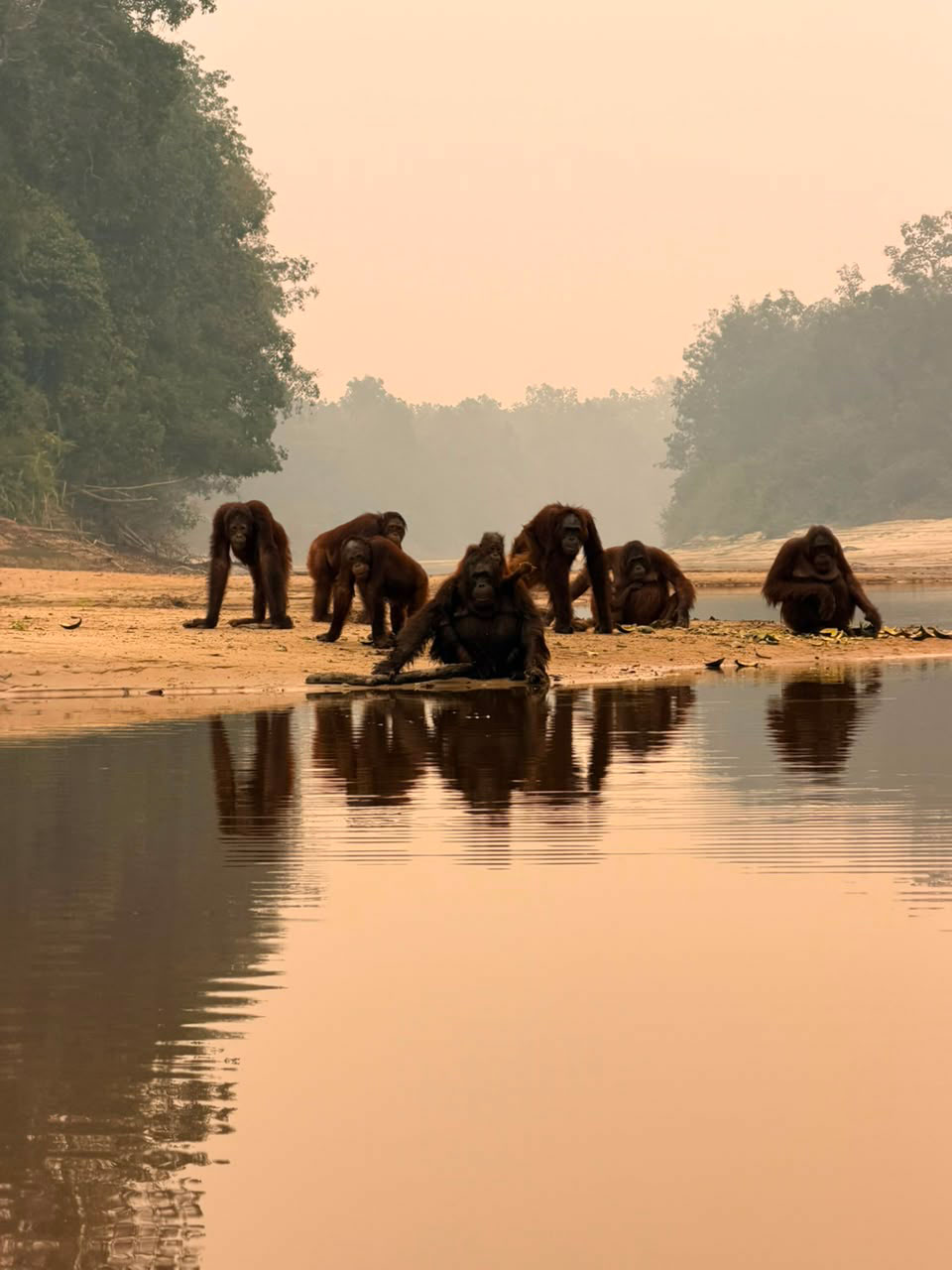
The hazardous air, especially in Central Kalimantan persists. The sky often glows ominously with a deep orange with haze. In the neighboring Southeast Asian countries of Singapore and Malaysia, the wind has brought the haze as well. The fires in Indonesia are so profound that even residents of the neighboring countries are now breathing in very unhealthy air.
Please donate to support the courageous firefighting teams. We will do all we can to provide them with more manpower and equipment.
Donate via credit card on our main Donate Page by following this link:
DonateDonate via Paypal by using this link:
Update: Oct 9th
We all took a deep breath as some showers brought a touch of relief to Borneo – but many of the fires continue to burn. The news is mixed, in some areas they are coming under control, but just as quickly new fires are popping up across the landscape. The firefighters are tired, but the battle is far from over.
The worst news comes from the Mawas Conservation Area where BOSF and other organizations are fighting fires across more than 1,150 ha, an increase of 827 ha from just last week. In 2022, Orangutan Outreach collaborated with BOSF to replant 28 ha over 3 years. We just wrapped up the reforestation project last year and now flames are threatening the area…
In terms of air quality, the conditions in Central Kalimantan are still dire as the daily rating still comes in between 500-700, which is extremely hazardous. The number of orangutans at the Nyaru Menteng Rehabilitation Center with respiratory issues has increased from 44 to 46. In West Kalimantan, there has been a slight improvement with the air quality now just considered “unhealthy” instead of hazardous.
Update: Sept 29th
Another week, more fires, and more toxic haze. However, a new threat has emerged. Water shortages are growing more commonplace across Borneo and not just for fighting fires, but for drinking water as well. This threatens the health of humans and orangutans alike.
On the orangutan front, there has been a dramatic rescue by BOSF of a young female orangutan from the center of an area that had been consumed by fires. She took refuge in one of the few remaining trees, but had sustained burns from walking across the smoldering ground. She has been admitted to the Nyaru Menteng Rehabilitation Center for treatment. At the center, there are now 44 orangutans suffering from respiratory distress due to the haze. The only sliver of good news is that some rain has offered minor reprieve from the smoke – bringing the air quality rating down from hazardous to very unhealthy…
All four of our partners, YIARI, BNF, BOSF, and CAN continue to take action to fight fires. The largest fire, the 30 km long fire front threatening Sebangau National Park continues to challenge BNF and local communities. It has devastated reforestation areas, but they have managed to keep it from entering the heart of the national park. In the Mawas Conservation Area, the fires being fought by BOSF have grown to 327.8 ha. They have successfully stopped its advance on one side only for the other to start to grow. Everyday, the communities and fire fighting teams are acting to save their homes, forests, and orangutans.
Update: Sept 22nd
The fires continue to rage in Borneo— clearing forests and poisoning the air. In this update, we will start with the orangutan news. In West Kalimantan, YIARI continues to rescue an enormous number of orangutans. Over the last week they rescued another mother and infant pair, bringing the total number rescued to 20. In Central Kalimantan, BOSF was called in for their first rescue of an orangutan from fire, an adult male with minor injuries who was successfully taken to the rehabilitation center. In East Kalimantan, CAN is rescuing a myriad of species, including 13 orangutans. Of these orangutans, 10 were directly moved to safe forests while the remaining 3 are now undergoing rehabilitation at a qualified center.
The teams of YIARI, BNF, BOSF, and CAN all continue to fight active fires. The largest fire front is at the edge of Sebangau National Park, spanning over 30 km. The BNF teams, together with community members, have been fighting it for nearly a month. They have extinguished the fires in some locations, but overall the burn has been unrelenting. Since it’s peat forest, even when the fires are extinguished above ground, they often continue to smolder— and travel- below ground. It continues to threaten the thousands of people and orangutans who live within its reach.
Another large orangutan population is being threatened in the Mawas Conservation Area, where fires have now claimed 171.5 ha of land and 3 large blazes are growing. BOSF, local communities, and government teams are working to suppress the outbreaks.
Even where the flames don’t threaten humans and orangutans, the hazardous smoke still does. The largest orangutan rehabilitation center in the world, BOS Nyaru Menteng, sits at the center of the most dangerous haze. There, the orangutans are suffering from severe respiratory distress. Since the haze started in August until now, 38 individuals have exhibited symptoms and are receiving treatment. Furthermore, the lack of rain has caused the river levels to drop dangerously low and they can no longer fully contain some of the pre-release islands. The teams are monitoring and guarding areas that are high risk for orangutan crossings. They have also proactively moved some orangutans off of the islands and to more secure enclosures for the remainder of the dry season.
Update: Sept 15th
In Borneo, humans, orangutans, and forests continue to suffer due to widespread wildfires. Over the last week, YIARI teams have rescued another seven orangutans from fires and smoke, bringing the total number of rescued orangutans in West Kalimantan to 18. The conditions of the rescued individuals vary drastically, but many are suffering from acute respiratory ailments and severe malnourishment. Several individuals also have burns from traversing smoldering peatland.
In the Mawas Conservation Area of Central Kalimantan, fires have reignited, bringing the total burned area up to 70.5 ha. This includes currently active fires in the Tuanan Orangutan Research Area, a peatswamp forest home to around 2,500 wild orangutans and an orangutan research initiative that has operated in collaboration with BOSF since 2002. As one of the world’s largest remaining wild orangutan populations and critical source of carbon storage, it is of global importance that these fires are contained as quickly as possible.
Update: Sept 11th
All of the field teams continue to hold on as they battle unrelenting fires. In West and East Kalimantan, the YIARI and CAN teams have been called in to rescue dozens of orangutans from fire outbreaks. Tragically, at least one orangutan did not survive. The rest are now receiving care in rescue centers or moved to safe forest.
In Central Kalimantan, the BOSF teams’ biggest concern is the hazardous smoke that has caused acute respiratory distress in 21 orangutans at the Nyaru Menteng Orangutan Rehabilitation Center. Not too far away, the BNF teams continue to work with communities to control the fires surrounding Sebangau National Park.
Update: Sept 2nd
Sebangau National Park, home to thousands of wild orangutans and countless other species, is now under direct threat from wildfires. While they have not yet reached the interior of the Park, fires now burn in multiple locations around the park. Along the northeastern border, 30 km of fire is closing in. Fires are also creeping in from Batu Ampar, Bangah, Kalampangan, and Marang regions.
The sheer scale of these fires is terrifying. The Borneo Nature Foundation is working with government teams, local communities, and universities to push back the outbreaks, but it is not enough.
Fires have already consumed one of the reforestation sites and threaten many others. The teams are working as fast as they can to rewet the earth where that is possible. In other areas, it is so dry and hot that they are unable to even transport the firefighting equipment. In this situation, all hands are needed to save what remains.
Please donate to support the firefighting teams as they work without rest. They desperately need more manpower and equipment:
Donate via credit card on our main Donate Page by following this link:
DonateDonate via Paypal by using this link:
Update: Aug 28th
The air quality index is a scale that measures air pollution and easily shows when it becomes dangerous to breathe in a specific area. In general, the lower the number, the better. For healthy air, the index should be 0-50. At 151, the air becomes unhealthy to breathe and anything above 300 is considered hazardous.
Right now, due to the fires, across nearly all of Kalimantan, home of the Bornean orangutan, the air is over 300 and hazardous to breathe. In the city of Palangka raya, home to BOSF’s Nyaru Menteng Orangutan Rehabilitation Center, some air quality stations have registered measures over 1,000.
What this means is not only is every breath uncomfortable, but the likelihood for long-term respiratory disease is now very high for humans, orangutans, and wildlife alike. Death has become unavoidable and while we can fight the flames, we are powerless to fight the smoke. We will also state the obvious: Animals do not wear masks. Nor do they have the luxury of staying indoors.
You can explore the global air quality map yourself in real time on the IQAir website.
The U.S. Air Quality Index runs from 0 to 500, with higher numbers meaning more pollution and greater health risks. It uses six color-coded categories:
• Good (0–50 – Green): Air quality is clean and poses little or no risk.
• Moderate (51–100 – Yellow): Air quality is acceptable, though sensitive individuals might face minor issues.
• Unhealthy for Sensitive Groups (101–150 – Orange): People with respiratory conditions, children, and older adults may experience health effects.
• Unhealthy (151–200 – Red): Everyone may begin to experience health effects; sensitive groups risk more serious issues.
• Very Unhealthy (201–300 – Purple): Triggers health alerts for emergency conditions affecting the general public.
• Hazardous (301–500 – Maroon): Serious risk of emergency conditions for the entire population
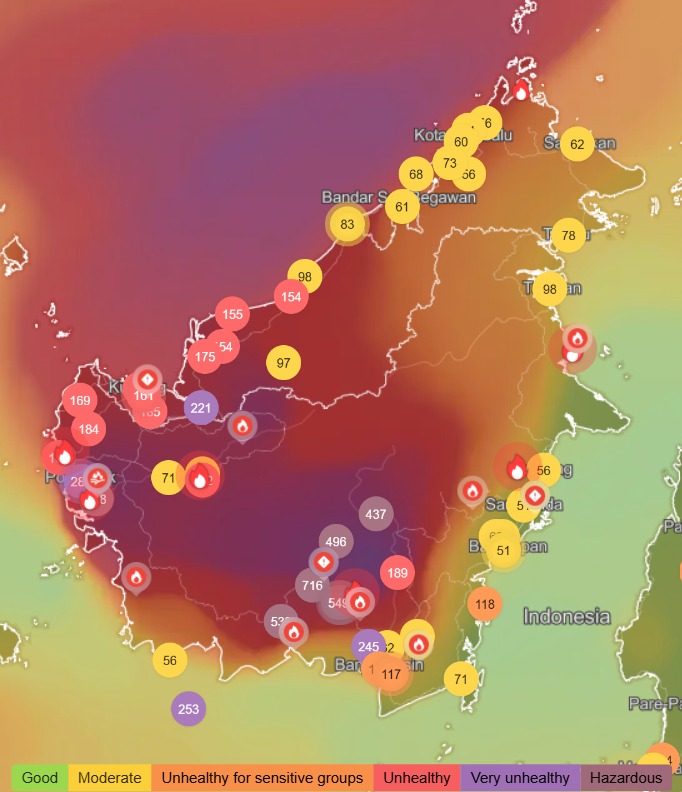
Map: Borneo Air Quality, August 28th, 2026.
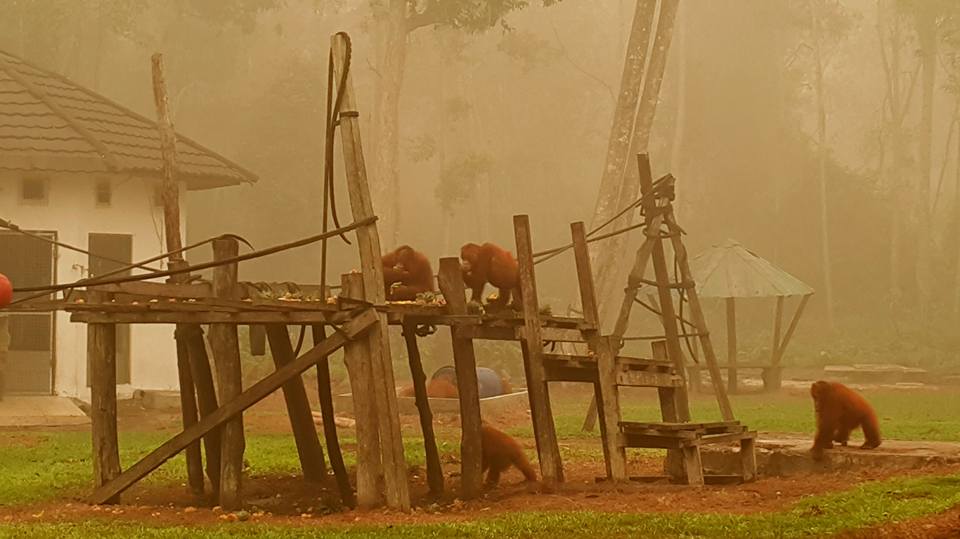
Note: This photo from BOS Nyaru Menteng is from a previous fire season.
Here is a recent TV interview with Dr. Karmele Llano Sanchez, Director of YIARI
Update: Aug 14th
Thankfully the raging fire at the edge of the YIARI Ketapang Orangutan Rehabilitation Center in West Borneo has been brought under control thanks to teams fighting the flames day and night.
The 60 orangutans living at the center are still in danger.
Peat fires can continue smoldering beneath the ground long after flames have disappeared – and these “zombie fires” can flare up at any moment. Teams are working around the clock to cool and water the land and monitor for critical hotspots. Donations are still desperately needed.
At the same time, the Borneo Nature Foundation firefighting teams and the BOS Foundation firefighting teams are also tackling fires over in Central Kalimantan. And in East Kalimantan, CAN is working with community members to fight countless fires across Berau. One fire has come within 100 meters of their wildlife rehabilitation center and another within two kilometers of the orangutan habitat in the Karaitan Protection Forest. Combined, the fires are estimated to be burning 1,500 ha within their working areas. More supplies & equipment are needed. Donations are still desperately needed.
THANK YOU TO EVERYONE WHO HAS ANSWERED OUR CALL FOR HELP AND DONATED TO OUR EMERGENCY FIRE FUND APPEAL. WE TRULY APPRECIATE YOUR GENEROSITY!
Update: Aug 12
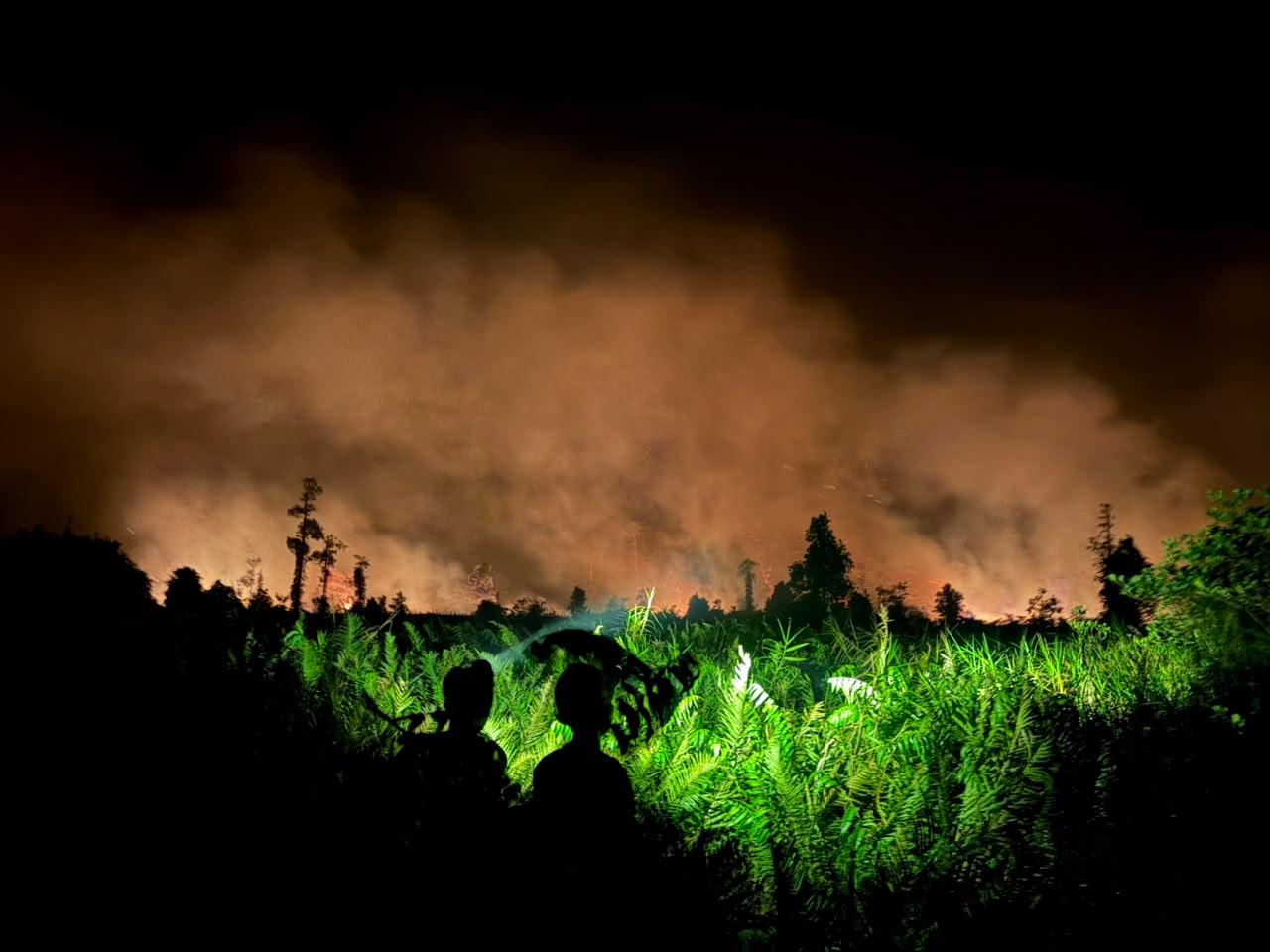
Fires are raging at the edge of the YIARI Orangutan Rescue, Rehabilitation and Conservation Center in Ketapang, West Borneo. Day and night, the teams are fighting the flames. The need is urgent and the stakes are life and death.
The center is home to 60 orangutans and spans 150 ha that includes carbon-rich peatswamp forests. We need to stay vigilant to ensure the safety of the humans, orangutans, and forests there. The only silver-lining is that the team is experienced and prepared. An existing program, The Power of Mama, is a women-led, community-based fire-fighting initiative that mobilizes teams across the province.
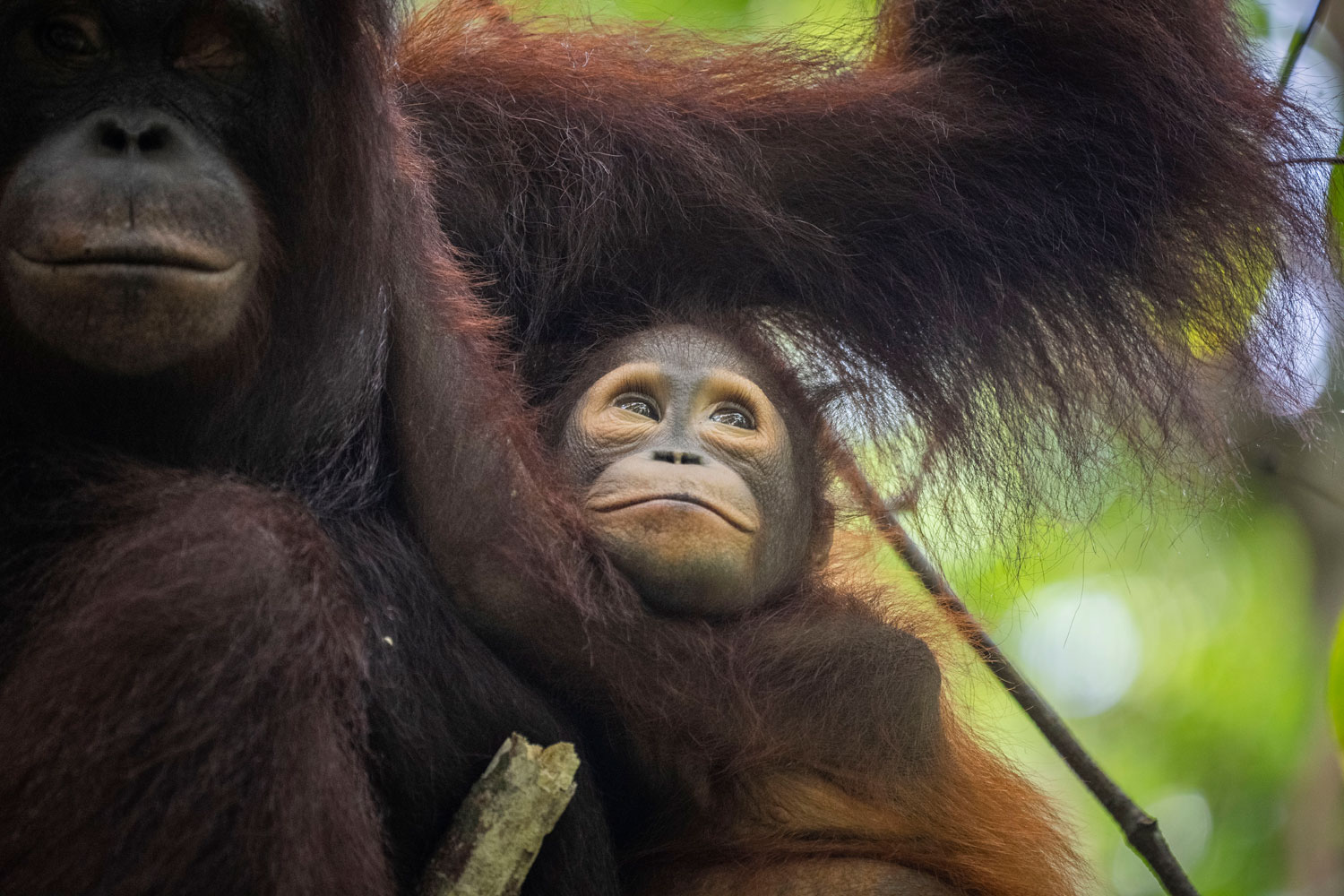
For those of you who are members of our adoption program, Ketapang is home to Pingky, Neng, JoJo, Rickina & Ricko, Kukur, Gatot and Mawa & Temon (pictured below). We are getting regular updates from the team. So far, everyone is safe, but the smoke is a serious concern for everyone at the center.
Please donate to help support the hiring of additional fire-fighting personnel and the purchase of more fire-fighting equipment. Now is not the time to hesitate.
Donate via credit card on our main Donate Page by following this link:
DonateDonate via Paypal by using this link:
The Orangutan Outreach Emergency Fire Fund is supporting the BOS Foundation, YIARI, the Borneo Nature Foundation and the Conservation Action Network Indonesia. Alongside local communities and government officials, the teams are working around the clock to put out fires as well as patrolling forests and peat swamps in remote areas of Borneo.
The Super El Nino
Every year the dry season raises the risks of fire in Indonesia and in orangutan homes. This year the threat is higher than ever because of a “super” El Niño.
El Niño is a weather phenomenon that hits Indonesia every few years, bringing even higher temperatures and extreme drought. When it strikes, fires grow larger and more uncontrollable than ever before. In 2015, the fires during the super El Niño burned over 2.6 million ha of land in Indonesia and required that hundreds of orangutans be evacuated. The outbreaks released so much carbon dioxide that it caused respiratory distress in animals and humans alike, killing an estimated 100,000 people.
Now, climate scientists predict that the 2026 fire season may be just as catastrophic.
The Threat to Orangutans and People
If we don’t prevent these fires and stop outbreaks from spreading we risk losing primary rainforests rich in biodiversity, releasing tons of carbon in the form of hazardous haze, and killing countless orangutans.
Many forests in Indonesia grow on peatland, which is so rich in carbon that fires can even burn underground. This means that once the burns begin, they can be almost impossible to extinguish and can burn for weeks or even months. As they burn, a haze blankets the land. Young orangutans and human children are prone to develop respiratory illness even if the flames do not reach their homes. However, the agricultural areas around cities and reforestation sites are at high risk for fires and can result in the flames striking orangutan rehabilitation centers directly.
These fires threaten the lives of orangutans today with trauma and sickness and they threaten the future of orangutans by taking away their forest homes.
How You Can Help
We must be proactive and ready to react – quickly.
We are working with our partners, Yayasan Inisiasi Alam Rehabilitasi Indonesia (YIARI), Borneo Orangutan Survival Foundation (BOSF), Borneo Nature Foundation (BNF) and Conservation Action Network Indonesia (CAN) to support their firefighting programs. All three manage huge swaths of rainforest and reforestation areas across Borneo that are home to thousands of orangutans and are important resources for local, indigenous communities. To keep these forests safe, they have established partnerships with villages to employ fire patrol and firefightings teams. Ahead of the fire season, we are ensuring the teams are trained and fully equipped to fight fires.
Now that the risk for fires is high, the teams are conducting patrols frequently and are ready to respond if there is an outbreak. Every minute matters when it comes to getting a fire outbreak under control.
Donate to our Emergency Fire Fund!
Donations will help pay for staff, equipment, medical supplies and fire-fighting gear. The situation is growing critical! Thank you for your support in these challenging times.
Suggested donations:
USD $25.00 — Firefighting gear: gloves, goggles, eye drops, masks
USD $50.00 — Forest recovery: 10 tropical hardwood saplings
USD $100.00 — Build a dam to block the ex-logging canals in the peat forests
USD $200.00 — Dig a deep well to supply water for firefighting
USD $500.00 — Equip a fire-fighting team with hoses, nozzles and safety equipment
Donate via credit card on our main Donate Page by following this link:
DonateDonate via Paypal by using this link:
The Fire Feed
Latest Update: October 16, 2026
October 14, 2026
CAN has been very busy working with the BKSDA to rescue orangutans and other wildlife in East Kalimantan. On this day alone, they rescued 3 orangutans, bringing the total rescued by CAN this fire season to 22. They have also rescued pangolins, langur monkeys, and other species.
Over in Central Kalimantan, BOSF rescued a sub-adult female orangutan near the provincial capital of Palangka Raya.
October 12, 2026
From a village in Central Kalimantan, BOS Foundation with the BKSDA rescued an adult male orangutan from an active fire zone. Thankfully he was relatively uninjured as he only had minor wounds on his fingers and toes. He is being kept at the Nyaru Menteng until there is safe forest available for his release.
Their teams are being stretched thin as the fires in the Mawas Conservation Area continue to grow and have now affected over 1,000 ha.
October 9, 2026
In the Batu Nyambu Protection Forest, YIARI released eight of the orangutans rescued earlier in this fire season, Mama Man, Man, Mama Nopi, Nopi, Mama Lifa, Lifa, Naufal, and Nopan. This was a critical action as not only have these orangutans been returned to freedom, far from the fires, but also enabled the team to continue to rescue other orangutans. To date, the YIARI team has rescued 46 orangutans from fires in West Kalimantan.
September 26, 2026
A young female orangutan was found stranded in a tree surrounded by active fires. The BOS Foundation mobilized and successfully rescued the orangutan, later named Novita. She is now receiving care at the Nyaru Menteng Orangutan Rehabilitation Center as she had burns over all of her hands and feet. At the center, the team also cares for 44 orangutans with respiratory illnesses. This number is up from 38 orangutans the week prior.
September 22, 2026
In the Mawas Conservation Area, a mixed peatswamp forest protected by BOSF, there are three fires of particular concern and the total area currently estimated to have been burned is 171.5 ha.
September 21, 2026
In East Kalimantan, the CAN teams continue to fight fires and rescue orangutans. The recent rescues bring the total number for the fire season so far to 13 individuals.
In Central Kalimantan, the BNF firefighting teams and communities continue to face a massive fire front spanning over 30 km along the edge of Sebangau National Park. Three weeks of fighting this fire has still not been enough to reduce its terrifying size and threat. At BOSF’s Nyaru Menteng Orangutan Rehabilitation Center, the number of orangutans suffering from respiratory symptoms has risen from 31 to 38 individuals.
September 17, 2026
The YIARI rescue teams have saved another mother and her month-old infant from fires in West Kalimantan. While they did not have visible burns, the mother orangutan was running a high temperature which required immediate treatment. The pair were named Mama Lifa and Lifa and were successfully brought to the YIARI Ketapang Rescue Center for further treatment.
September 15, 2026
Fires have started yet again in the Mawas Conservation Area, managed by BOSF. On September 11, a 14 ha fire broke out around the Tuanan Orangutan Research Area and while firefighting teams have mobilized, it is continuing to burn 4 days later. At the same time, further to the south near the village of Mangtangai, another 7 ha fire is raging.
September 14, 2026
In a burning area of Tumbang Nusa, BOSF and the government Wildlife Rescue Unit rescued a male orangutan with injuries on his left hand and foot. He is now safely receiving care at BOSF’s Nyaru Menteng Rehabilitation Center. This was their first fire-related orangutan rescue of the year.
September 13, 2026
At BOSF’s Nyaru Menteng Orangutan Rehabilitation Center, the number of orangutans suffering from respiratory symptoms has risen from 21 to 31 individuals. The air quality in the area is still consistently close to 1,000 – extremely hazardous to the health of all.
September 12, 2026
Another three orangutans were rescued by the YIARI team, this time an adult male (Kumbang) and a mother and child (Mama Penja and Penja). The mother and child were rescued in the buffer area around Gunung Palung National Park. They both needed urgent veterinary care, including IV fluids and oxygen. The mother’s skin was peeling from the burns she most likely sustained walking over burning peatland. To make matters even worse, both were severely malnourished and dehydrated.
The male was identified as a previously rescued and released orangutan from 2022. He was found suffering from respiratory distress as well as external wounds and scars. It is likely that he had been previously shot with air rifles and caught in a hunting snare. In addition to the field treatment, all three orangutans were taken to the YIARI rescue center for more intensive veterinary examinations and care.
September 10, 2026
The firefighting teams from CAN are concentrating their efforts on their remaining reforestation areas in East and West Kalimantan. Combined, the areas include over 3,000 ha of young, newly planted trees. Most of them have already been burned and destroyed by the fires.
September 8, 2026
Only four days later, the YIARI team returned to the rescue location from September 4 to rescue two more orangutans, another mother and child, Mama Noni and Noni. While Noni continued to nurse, Mama Noni had an elevated body temperature requiring immediate treatment. YIARI has now rescued a total of 15 orangutans this year from fires.
September 6, 2026
The BOS Foundation teams continue to be most impacted by the haze and the respiratory distress it brings to the orangutans. However, to prevent fire outbreaks close to the center, their firefighting teams are supporting government firefighting efforts in the city and around 10 km from the center.
September 4, 2026
The YIARI team rescued four orangutans, Naufal, Nopan, and a mother-child pair named Mama Nopi and Nopi. The orangutans were in generally good condition, except for Nopan, who had a fever. Immediate treatment and intravenous fluids brought his temperature back down. All four orangutans were taken to the rescue center for continued care.
September 3, 2026
At BOSF’s Nyaru Menteng Orangutan Rehabilitation Center, the air quality has been hazardous for weeks. Now, 21 orangutans are presenting new symptoms of respiratory distress. The veterinary team there is providing treatment, but they cannot stop the orangutans from inhaling the smoke and they expect for more orangutans to fall ill.
September 2, 2026
Sebangau National Park, home to thousands of orangutans, is becoming surrounded by fires. The BNF and community firefighting teams are taking on a blaze that stretches uninterrupted for 30 km along the northeastern border of the park. Fires are also appearing within the park and in community forests. The teams are stretched thin, working nonstop, and are overwhelmed.
September 1, 2026
On August 30, YIARI carried out its 7th rescue of an orangutan endangered by the fires. In this case, a male orangutan was found unconscious in a palm oil plantation. The veterinary team stabilized him for transport to the rehabilitation center. Tragically, he passed away two days later on September 1. The necropsy revealed that he died of respiratory arrest following smoke exposure. This orangutan, named Sampurna, is the first death we have recorded from the fires.
September 1, 2026
In East Kalimantan, fires are spreading quickly, leaving the CAN team stretched thin as they work to fight flames across an estimated 1,500 ha. One fire has come within 100 m of their wildlife rehabilitation center, which is home to orangutans, gibbons, sun bears, birds, and many other species. Another fire is approaching the Karaitan Protection Forest, a key habitat for orangutans in the area.
August 28, 2026
The fires in Borneo continue to burn. Just as dangerous as the flames, the air has become hazardous to breathe as smoke from the fires covers the entire island. Air quality indexes show that much of the air in Central and West Kalimantan is hazardous to breathe, with a reading of over 300 nearly everywhere. In Palangka raya, where the Nyaru Menteng Orangutan Rehabilitation Center is, the index is over 1000.
August 14, 2026
Outstanding support has enabled the YIARI team to fight the fires outside of their orangutan rehabilitation center day and night for four days straight. This, combined with waterbombing by the Indonesian government, has brought the blazes under control. Now hotspots still surround the center so the teams are preparing for the return of “zombie fires”. These are underground fires that can reach the surface after the main blaze is extinguished.
August 12, 2026
In the Mawas Conservation Area, a mixed peatswamp forest protected by the BOS Foundation, fires have already burned through 43 ha of land.
August 12, 2026
The fires are now 100 m from the YIARI orangutan rehabilitation center in West Kalimantan. All orangutans have been evacuated from the forest enclosures and into safer cages in the middle of the center.
August 10, 2026
The previous burn that was 1 km from the YIARI orangutan rehabilitation center in West Kalimantan has reignited and is now only 300 m from the center. The teams are now battling the blaze around the clock.
August 6, 2026
A joint team from YIARI and government agencies rescued a male orangutan from a village plantation who was under threat from forest fires in the immediate area. The area suffered from fires in 2015 and 2019 attributed to widespread land clearing.
July 31, 2026
Indonesia’s weather agency detected 5,019 wildfire hotspots as of mid-July 2026, with the number rising faster than during previous El Niño events in 2015, 2019, and 2023.
July 22, 2026
Fires covering 29 ha broke out just 1 km away from the YIARI orangutan rehabilitation center in West Kalimantan. YIARI teams on the ground battled the fires with aerial support from the National Disaster Management Agency (BNPB), dropping water from above with helicopters.
May 2026
The fires in Pematung Gadung were brought under control by the YIARI and community firefighting teams.
March 2026
Fires covering about 5 ha started in Pematung Gadung, a community-powered reforestation site and just 28 miles from the YIARI orangutan rehabilitation center in West Kalimantan.
Fire Fund FAQs
All funds donated to firefighting are used for rapid response to fight fires directly or for fire prevention measures.
For donations made during the fire season (June-November), they will be held in the form of an emergency fund. In the case of fire outbreak in or around the working area of an Orangutan Outreach’s partner, if they do not have the funds to mobilize a firefighting team, Orangutan Outreach will provide funding if the emergency funds are sufficient. In the case of multiple outbreaks, the Orangutan Outreach team will allocate funds based on the need and risk level for orangutans and humans.
If there are funds still held in the Orangutan Outreach’s emergency fire fund at the end of the fire season or donations are made during the wet season (December-May), Orangutan Outreach will hold the funds until the following fire season or allocate them towards fire prevention measures such as, but not limited to deep well/water reservoir construction, canal damming, equipment acquisition, firefighting training, or community outreach on fire prevention.
As a tropical country, fires do not start naturally in Indonesia. All wildfires start as smaller human-made fires that grow out of control. Typically fire is used to clear agricultural land or in cases of arson for land-grabbing. While both are illegal in Indonesia, instances of each are still reported every year.
Traditionally, small farmers would use fires to clear land prior to planting – and when this occurs near healthy forest, this is not dangerous as healthy, established rainforests with high water tables can naturally regulate fire. However, large-scale development has cleared and degraded much of this forest cover and caused the draining of water tables. Now, due to the conditions created by humans, even a small fire can quickly grow out of control.
Firefighting teams are made by organizations, villages, and the government. When an outbreak is reported, the team needs to take all necessary equipment to the fire location. The teams are equipped with water pumps, but they must have a source of water to use the pumps and hoses. The most common water sources are a nearby river or a previously prepared deep well or water reservoir. These man-made water sources are critical for firefighting in remote areas, but they must be prepared months in advance of the dry season to be usable.
When outbreaks are particularly large, the Indonesian National Agency for Disaster Management (BNPB) can mobilize helicopters to carry out “water bombing.” These are aerial drops of huge amounts of water (upwards of 800 L per drop) that are carried out repeatedly to extinguish flames. This is the most effective way to stop an active fire blaze, however, limited availability of helicopters and other resources makes it impossible for water bombing to be used on every fire when outbreaks are widespread across the archipelago nation.
In Indonesia, forest fires don’t mean that just the trees are burning, but also the ground. Many forests are on peatland. Peat is a carbon-rich type of earth and when it burns, it is similar to a slow-burning fuel. Under these very special forests, the peat penetrates deep underground in a reserve dome. The Mawas Conservation Area, a working area of Orangutan Outreach’s partner, BOSF, has a double dome of peat. Here it reaches some of the greatest depths in the world for peat, 18 m or 60 f.
A dense, slow-burning solid fuel source spanning dozens of feet into the earth means fires can burn under the surface. Imagine a fire starts in one location and is extinguished at the surface, but unbeknownst to the team, underground the fire continues to burn and move. Soon it reaches the surface in a new location and they must begin to fight the same fire all over again.
When we are looking at fires that burn millions of hectares, the world suddenly becomes a much smaller place. The fires in Indonesia are particularly dangerous for the rest of the world because of the peatland that burns there. Peat is a carbon-rich type of earth, meaning that when it burns, it produces carbon emissions, just like burning coal or gasoline. In 2015, widespread fires in Indonesia resulted in the emission of more greenhouse gases each day than all U.S. economic activities combined. This had two disastrous results.
Across Southeast Asia, the winds carried the hazard haze from these fires into other countries such as Singapore and Malaysia. People across the region suffered from respiratory illnesses, which is estimated to have contributed to the death of upwards of 100,000 people. Furthermore, these emissions are potent greenhouse gases and make significant contributions to global climate change, which is resulting in more extreme weather events across the globe. We all need to care about the fires in Indonesia.